« A spate of mysterious murders are being committed across the city and the police are groping in the dark, that is until a police commissioner decides to start his own detailed and thorough investigation, determined to put an end to this long, incessant series of killings, carried out by a murderer with a strange claw. In the final conclusion of this tangled web of mystery, the murderer is arrested and he turns to be none other than a prisoner escaped from the local prison, eager for revenge. » [“Dictionary of Italian cinema“, by R.Chiti, E.Lancia. I Film, vol.I, from 1930 to 1944. Edizioni Gremese, Rome, 1993]
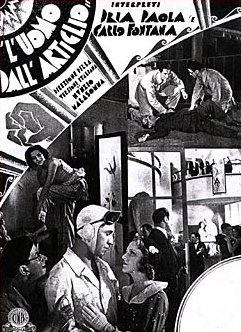
1. Note-Notes: Filmed in the Cines studios. Giacomo Gentilomo, future screenwriter and directer, makes his first appearance in the world of cinema with the script.
2. Note-Notes: In the book Ma l’amore no, Francesco Savio remembers: “…Shot in Rome, simultaneously with the German version directed by Hans Steinhoff, with the title Pranke (1931). The national film archives in Rome is in possession of a copy of The Man With the Claw but it’s the German version dubbed into Italian! We find ourselves in a unique situation with a film distributed in the Italian market in two different versions: the (original) Italian version and the German version derived from a script by Rudolf Katscher, Ego Eis and Otto Eis. These are the Italian credits in the German version: Cines Pittaluga presents / The Man With the Claw / Directed by Hans Steinhoff // car racing scenes filmed at Littorio racetrack in Rome // sound engineer Pietro Cavazzuti / editor dott. Tomka Rey Taldy / production manager Carlheinz Jerosy //”
3. Note-Notes: critical review from the time: “ The crime “genre” has its admirers. So there’s nothing wrong with a big studio tending to their needs. But you need to choose your scripts wisely, and there’s no shortage of them. Why bother inventing them when there are thousands of them, one better than the other? The premise isn’t bad, notably the unusual backdrop of the sports world. But the action scenes are slow and muddled and there is far too much padding …The directors have wasted their time on pointless details, devoid of any drama or interest. The film holds its own with some well-lit photography together with first class actors. The beautiful and talented Dria Paolain, in a role unworthy of her abilities, gives a dedicated performance. ( Enrico Roma, in Cinema Illustrazione, novembre 1931)
Director Nunzio Malasomma
Film director, born in Caserta on February 4, 1894 and died in Rome on January 12, 1974.
After a significant apprenticeship in silent cinema, he went on to become a prolific director of comedies with theatrical roots, during the thirties and forties, with some of the most successful actors of the times. He also experimented with expertise in genre cinema.
After graduating in engineering, he began to take an interest in entertainment editing the combative cinema and theatre journal “Fortunio” (1920) with Luciano Doria. His debut as a director came with Journey Into the Impossible (1923), co-directed by Doria and starring the athlete Giovanni Reicevich.
The following year he went to Germany with Gennaro Righelli, where he wrote three screenplays before returning to directing with Mister Radio (1924), co-directed with Luciano Albertini and the first of a series of ‘acrobatic’ films with Albertini and Carlo Aldini himself, all centred on the tightrope walkers and the ‘strong men’. He continued working in Germany until the late 1920s, making three mountain-setting films with Mario Bonnard, starring future director Luis Trenker.
Returning to Italy with the advent of sound, within a few years he became one of the most active artisans of popular cinema, alternating between gialli, The Man With the Claw (1931) and comedy, the genre in which he was most successful. After The Telephone Operator (1932), inspired by a wave of films then in vogue in Italy and Germany, Malasomma directed two more comedies for the big screen by A. De Benedetti, Lohengrin (1936) and I Don’t Know You Anymore (1936), centred on the kind natured Don Juanism of the protagonist (Vittorio De Sica). He then made a polite parody of the prison film set in an American prison-model (Things from the other world, 1939), and After Divorce (1940), from the comedy of the same name by A. De Stefani, a singular example of a film belonging to the ‘white telephones’ characterized by glossy and choreographic interiors and brightly interpreted by Amedeo Nazzari and Lilia Silvi, who found themselves together again in Scampolo (1941), based on the comedy by D. Niccodemi. After the war, M.’s greatest success was The White Devil (1947), adventurous epic of a young Caucasian prince (Rossano Brazzi) who becomes the legendary champion of the oppressed. The meeting with Gilberto Govi for Il diavolo in convent (1950) gave rise to one of the happiest cinematographic appearances of the popular Genoese actor. In the Sixties – after the peplum La rebellion of the slaves (1960), loosely based on the novel Fabio-la by N. Wiseman – M. made his last film, 15 Forks for the Assassin (1967), a spaghetti-western with yellow intrigue lapels. [Orio Caldiron / Encyclopedia of Cinema / 2003]
References
 One Man and His Droid
Pingback: Giallo Filmography | One Man and His Droid